Comparison · Ad blockers
AdGuard vs uBlock Origin
One is paid and blocks across your whole device. The other is free and lives in your browser. Here's the honest difference — and why the answer might be "both."
Last updated: July 10, 2026 · Both extensions tested by the Privacy Intact team with our automated harness (June 8, 2026).
Choose uBlock Origin if…
You browse on a desktop, want it free, and use Firefox (or are fine with the Lite version on Chrome).
Choose AdGuard if…
You want blocking on your phone and inside apps, across multiple devices, with minimal fuss.
Overall effectiveness — our rating
A browser benchmark measures one thing in one place. Our overall rating weighs what actually decides real-world usefulness — and AdGuard comes out ahead despite scoring lower on the raw browser test, because it works where uBlock can't (your phone, inside apps, and Chrome — where uBlock's full version no longer runs).
| Dimension | Weight | AdGuard | uBlock |
|---|---|---|---|
| In-browser blocking power · measured (AdBlock Tester) | 25% | 7.7 | 9.6 |
| Coverage — phone, in-app & whole-device · editorial | 35% | 10 | 3 |
| Full strength on the browser you use (incl. Chrome's Manifest V3 limits) · editorial | 15% | 9 | 4 |
| Ease for non-technical users · editorial | 10% | 9 | 7 |
| Value for money · editorial | 15% | 6 | 10 |
| Overall (weighted) | 100% | 8.6 | 6.3 |
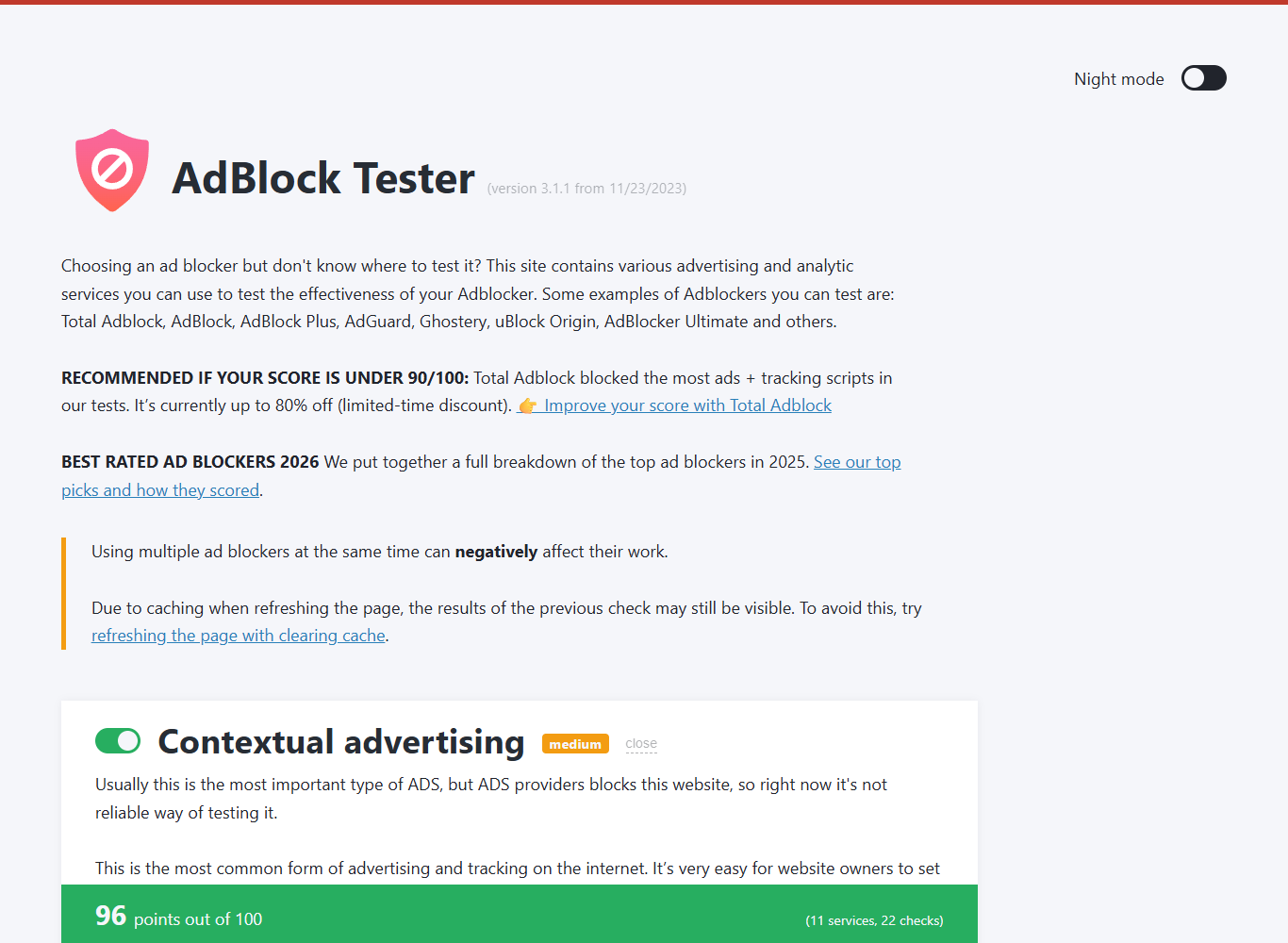
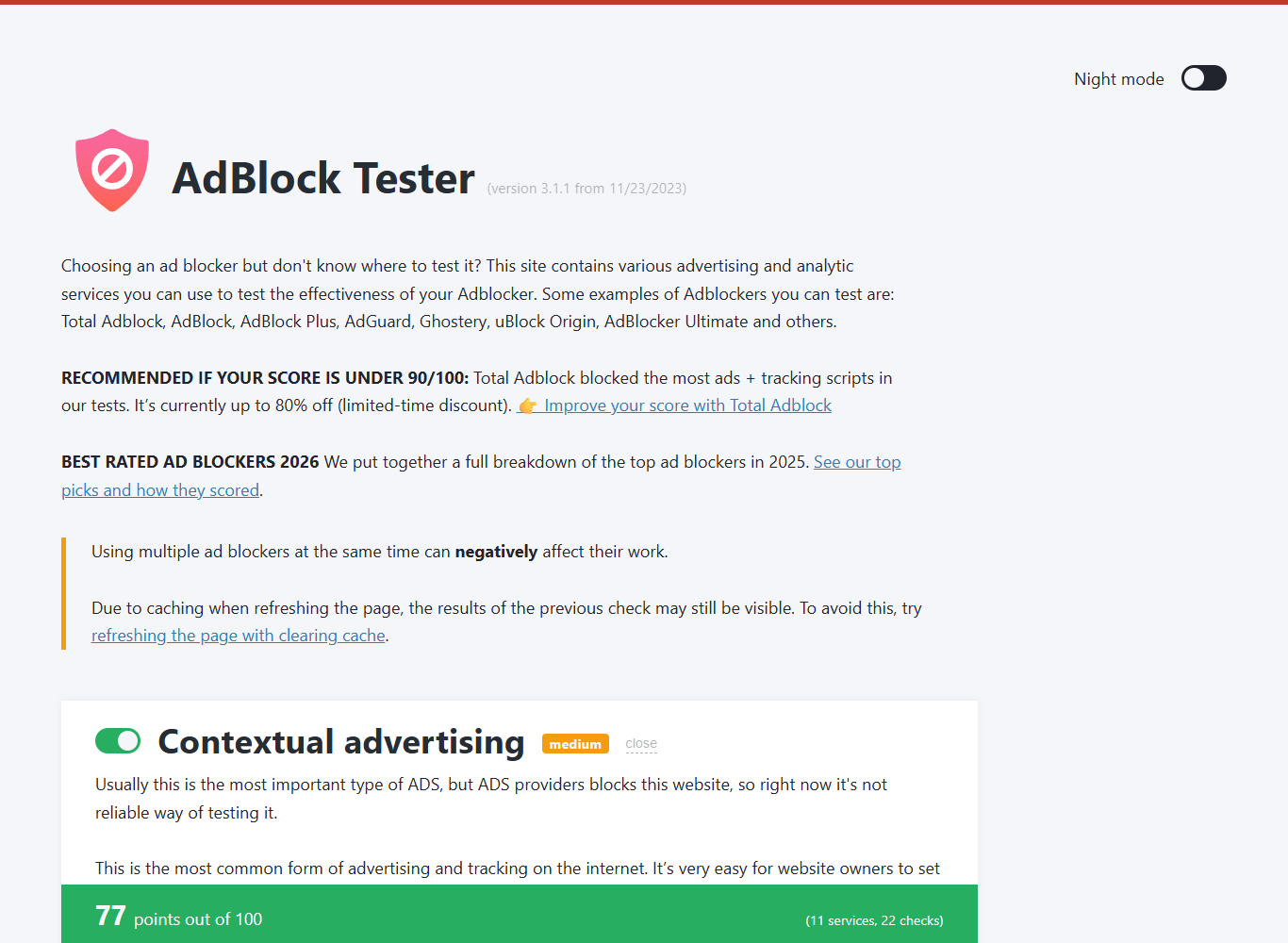
Sub-scores out of 10. Only "blocking power" is a measurement (our AdBlock Tester result, 77 vs 96 out of 100); the other four are our editorial assessment, shown with their weights so you can judge them. Weight it your way: if you only ever browse on desktop Firefox, push "blocking" and "value" up and uBlock wins — at $0. For most people — who use Chrome and a phone — coverage is why AdGuard leads.
Side by side
| AdGuard | uBlock Origin | |
|---|---|---|
| Price | Paid (one-time Lifetime or yearly) | Free & open-source |
| Our in-browser test (AdBlock Tester) | 77/100 (free ext, default) | 96/100 |
| Where it blocks | Whole device — browsers + other apps | Inside the browser only |
| Privacy & trust | Closed-source apps; installs a local root certificate to filter HTTPS; Cyprus-based, Russian-origin founders | Open-source; no certificate, no account |
| Platforms | Windows, Mac, Android; iOS (Safari + DNS only) | Firefox (full strength); Chrome = uBO Lite (weaker, MV3) |
| Mobile app ads | Android: in other apps; iOS: DNS-level only | No |
| Resource use | Extension is light; the system-wide app runs a background service | Famously lightweight |
| Best for | Mobile, mixed devices, non-technical users | Desktop browser users who want free |
Blocking power
In the browser, both are strong — but we measured a clear gap. Running each free extension through AdBlock Tester (adblock-tester.com) (each blocker in default config, 30-second filter-list warm-up, identical pages, June 8, 2026), uBlock Origin scored 96/100 and AdGuard's free extension 77/100 (Edge with no extension still blocked a chunk on its own, thanks to built-in tracking prevention). So for pure in-browser blocking, uBlock edged AdGuard in default config — the free tool blocked more. Read that as a default-config gap, not a final verdict: AdGuard's extension climbs with more filters enabled, and browser tests are noisy. AdGuard's real advantage isn't this score at all — it's that its paid apps filter at the system level, catching ads in other apps and across the whole device. If your world is one desktop browser, that reach doesn't matter and uBlock is the better, free choice; if it includes a phone, it's the whole game.
Coverage & platforms
This is the real dividing line. uBlock Origin is a browser extension: no browser, no blocking, and no mobile-app coverage. AdGuard installs as an app on Windows, macOS, Android and iOS and protects everything (within Apple's limits on iOS). For most people the practical question isn't "which blocks better in Chrome" — it's "do I also want my phone covered?"
The Chrome / Manifest V3 factor
Google's Manifest V3 change removed full uBlock Origin from Chrome — on Chrome and other Chromium browsers only the lighter, feature-reduced uBlock Origin Lite remains. To get uBlock Origin at full strength you run it on Firefox, which is unaffected. AdGuard's standalone apps don't depend on browser-extension rules at all, which is one reason it's more future-proof on the desktop.
Two honest caveats. First, AdGuard's own Chrome extension is bound by the same MV3 limits — on Chrome neither extension is at full power, and AdGuard's real edge there is its standalone app (which filters outside the extension model), not its extension. Second, uBlock Origin Lite, though reduced, is not useless: it still blocks the large majority of everyday ads and trackers (same developer, static rule sets); what it loses is dynamic per-site filtering and some anti-adblock rules. So a Chrome user isn't unprotected — you'd add AdGuard for phone and in-app coverage, not because Lite fails at browsing.
Price
uBlock Origin is free, full stop. AdGuard is paid — a one-time Lifetime license or a yearly plan, in Personal (3 devices) and Family (9 devices) tiers (per AdGuard's license page; verify current terms at checkout); direct purchases carry a 30-day money-back guarantee. Frequent promotions move the exact price, so check it live. If budget is the deciding factor and you're a desktop browser user, uBlock Origin wins on value alone. If you need device-wide coverage, AdGuard's price buys something uBlock Origin can't — and the Lifetime license avoids a recurring subscription.
Our recommendation: it's not either/or
The cleanest setup for many people is both: uBlock Origin in your desktop browser (free, superb), and AdGuard on your phone and any other devices where you want ads gone. If you must pick one and you live across devices, AdGuard is the safer all-rounder; if you live in a desktop browser, uBlock Origin is all you need.
How we test is in How We Review; the full breakdown is in our AdGuard review.
FAQ
Common questions
Is AdGuard or uBlock Origin better?
Neither is strictly 'better' — they solve different problems. uBlock Origin is the best free in-browser blocker, ideal on desktop Firefox. AdGuard blocks system-wide across apps and devices, which is what you want on mobile or for non-technical users.
Can I use both at the same time?
Yes, and plenty of people do: uBlock Origin in the desktop browser, AdGuard for the phone and other apps. There's no need to choose if your needs span both.
Is uBlock Origin really free?
Completely. It's free and open-source, with no accounts or upsells. Donations are welcome but optional.
Why is uBlock Origin limited on Chrome?
Google's Manifest V3 removed full uBlock Origin from Chrome; on Chromium browsers only uBlock Origin Lite remains — a lighter, separate build by the same developer. Lite still blocks the large majority of everyday ads and trackers; what it loses is dynamic per-site filtering and some anti-adblock rules. Full-strength uBlock Origin runs only on Firefox.
Need device-wide blocking?
If your phone and apps are part of the picture, AdGuard is the one to get. Prefer free, desktop-only? Grab uBlock Origin for Firefox.
The AdGuard link is an affiliate link — we may earn a commission at no extra cost to you. uBlock Origin is free, and we recommend it anyway where it's the better fit.